The theory test for class D (bus) draws on 1326 questions from the official bank. The test has 30 questions and you pass with at least 26 correct answers.
Questions per section
Rules and regulations: 620
Traffic signs: 380
Safety: 300
Know your vehicle: 26
Sample questions for class D
What does the law state as regards to fueling a vehicle which carries more than 11 passengers?
It is allowed to fuel the vehicle when it stands next to a fire extinguishing station.
It is allowed to fuel the vehicle, provided that a fire extinguisher is located close by.
It is forbidden to fuel the vehicle while passengers are still on board.✓ Correct answer
It is allowed by means of self-fueling.
Explanation. In a vehicle carrying more than 11 passengers, refuelling is forbidden while passengers are aboard, since fuel vapour and fire risk endanger a large group that is hard to evacuate. An extinguisher, a fire station or self-service does not allow it.
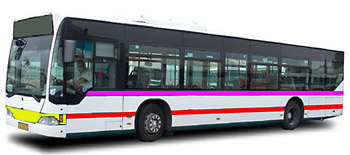
According to the law, what is the maximum allowed length of the bus in the following picture?
12 meters.
13.5 meters.✓ Correct answer
18.5 meters.
11 meters.
Explanation. The law limits a bus's length by its type. According to the official answer, the maximum for the bus in the picture is 13.5 metres. The 18.5 figure belongs to another type.
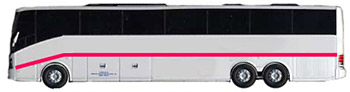
According to the law, what is the length limit of the bus in the following picture?
15 meters.✓ Correct answer
13.5 meters.
18.5 meters.
12 meters.
Explanation. The law sets a different maximum length by bus type, and for the bus shown the limit is 15 metres. The other figures in the options belong to other bus types.
A vehicle that is approved for transporting children is:
Any public bus on service route.
Any bus listed in a transportation company.
Any motor vehicle that is driving children.
A private bus or a public vehicle that has been licensed by the Ministry of transport .✓ Correct answer
Explanation. Children may be transported only in a vehicle specifically approved for it: a private bus or a public vehicle holding that approval. An ordinary service-route bus or any other motor vehicle is not enough.
Children should get on and off a student bus:
Far away from the sidewalk always.
From the front right door only.✓ Correct answer
From the rear door only.
From the front right door and from the rear door.
Explanation. Pupils get on and off only through the front right door, on the pavement side and in the driver's view. That keeps them off the carriageway. The rear door or getting off far from the pavement is dangerous.
What is “pupil transport” by bus?
Transporting of children to school or on an organized activity in an authorised vehicle.✓ Correct answer
Bus transportation of children or of students.
Bus transportation of children below 16 years of age..
Any transportation of a group of children in a bus, including service route.
Explanation. Pupil transport means carrying children to school or to an organised activity in a vehicle approved for that purpose. Children simply riding an ordinary service-route bus is not pupil transport.