The topic "Safety" has 400 questions in the official theory test bank, 306 of which appear in the private car (class B) test. Below are sample questions with the correct answer and an explanation.
When your vehicle or any passerby and property are at risk.✓ Correct answer
In a two-way roadway having 4 lanes.
When entering an acceleration lane.
Explanation. Slow down when there is a danger to your vehicle, other road users or property. Passing under a bridge, a four-lane road or an acceleration lane is not a hazard in itself; slowing is a response to real risk.
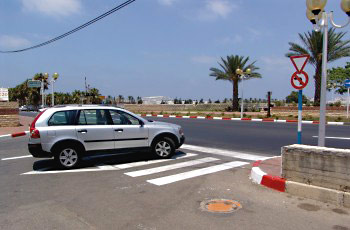
Always accelerate when entering the intersection, in order to avoid traffic disturbance.
Slow down and even stop if necessary in order to give right-of-way.✓ Correct answer
Cross it safely.
Stop anyway.
Explanation. The picture shows a give-way sign (inverted triangle): slow down and stop if needed to give way to traffic on the road you are joining. Do not speed up, but you need not stop if the road is clear.
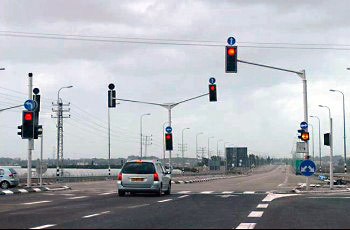
Give right-of-way to the traffic on the crossing road.
You should not obey the traffic light signals. Follow the road signs only.
Stop before the junction and do not enter into it.✓ Correct answer
Stop before the junction and then drive through uninterruptedly.
Explanation. A red traffic light means stop before the intersection and do not enter it. The light overrides the signs, and you cannot stop and then carry on when it is clear, because red forbids entry until it changes.
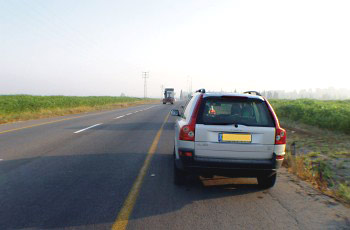
You should signal with your left hand and swiftly merge with traffic. .
You should signal appropriately and ensure that you can merge with the traffic without endangering other road users.✓ Correct answer
You should, before starting to drive, signal and then get on the road quickly.
Make a left-signal and drive. The other vehicle should give you right-of-way.
Explanation. When pulling away from a stop or parking space you are joining the traffic and have no priority. Signal and make sure you can merge without endangering or obstructing others. Speed and a hand signal alone are not enough.
Go to a higher gear to complete the gradient quickly.
Sow down, change down to a lower gear according to the gradient✓ Correct answer
Brake for a few seconds so as not to drive too fast
Travel in Neutral.
Explanation. On a long descent select a lower gear to suit the gradient so the engine helps to brake. A high gear lets the car speed up, constant braking overheats the brakes, and neutral gives you no engine braking or control.
In LPG-Vehicle permitted parking lots, according to the directions of the Vehicle’s importer.
In LPG-Vehicle permitted parking lots, according to the directions of the Ministry of Environmental Protection.✓ Correct answer
In regular parking lots designated for gasoline vehicles.
In parking lots designated for private passenger cars only.
Explanation. An LPG vehicle may park only in car parks permitted for it, following the Ministry of Environmental Protection guidelines, because flammable gas can collect in enclosed places. An ordinary petrol car park is not enough.
No, beer is not regarded as a drink which affects one’s driving.
Yes, beer has more alcohol than whisky.
No. They both have a more or less equal effect on the driver’s ability to drive safely.✓ Correct answer
No, the quantity of beer is greater and therefore its effect is greater.
Explanation. A can of beer and a shot of whisky contain roughly the same amount of pure alcohol, so they affect a driver about equally. Beer is a real alcoholic drink, and its bigger volume does not mean it has more alcohol.
Explanation. Alcohol disrupts coordination between eyes, hands and feet, so steering, braking and shifting gears together becomes harder. This is a standard effect of alcohol and does not depend on the particular driver.
It is only correct for drivers wearing eyeglasses.
Incorrect.
Explanation. Alcohol reduces visual sharpness at any time of day and in every driver, not only at night or for people with glasses. The picture gets blurrier, making signs and distant hazards harder to read.
Correct. Alcohol is a suppressive drug.✓ Correct answer
Incorrect. Alcohol improves your mood and your ability to drive.
Incorrect. Alcohol has a positive effect.
Incorrect. The driver feels that he cannot drive when he’s drunk.
Explanation. Alcohol is a depressant, so it slows the driver's reactions. The idea that a drunk person feels unable to drive is wrong: he usually feels confident, and that false confidence is exactly the danger.
From the moment the driver notices danger until the vehicle reaches a complete stop.
From the moment of applying the brakes until the vehicle reaches a complete stop.✓ Correct answer
From the moment the driver notices danger until he starts to brake.
Explanation. Braking distance is only the last part: from the moment you press the brake until the vehicle stops. The distance before you begin braking is the response distance, and together they make the stopping distance.
The stopping distance is always greater than the braking distance.✓ Correct answer
The response distance is always longer than the braking distance
The braking distance is always greater than the stopping distance.
The braking distance always equals the response distance.
Explanation. Stopping distance is response distance plus braking distance, so it is always greater than the braking distance alone. The other statements are not always true: the response distance is not always longer or equal to braking.