The topic "Traffic signs" has 391 questions in the official theory test bank, 363 of which appear in the private car (class B) test. Below are sample questions with the correct answer and an explanation.
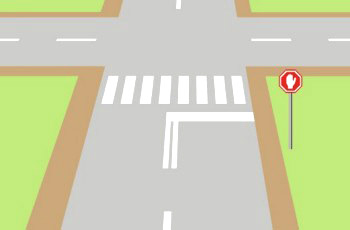
Before and close to the stop line.✓ Correct answer
You can stop anywhere, as long as you stop before entering the intersection.
After the pedestrian crossing, but before the intersection.
Explanation. When there is a stop line on the road, stop before it and close to it, not past the crossing or in the intersection. That keeps the crossing clear while still letting you see the traffic ahead.
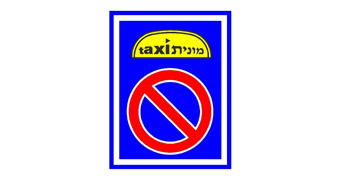
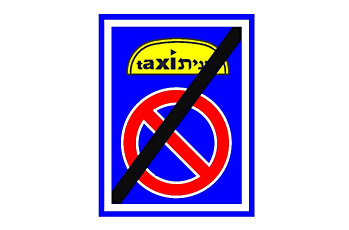
No, except for stopping in order to unload passengers.✓ Correct answer
Explanation. The sign marks a taxi space. Other vehicles may not leave a car there, and the only allowed exception is stopping to let passengers out. Picking up is not allowed, and an empty bay does not change that.
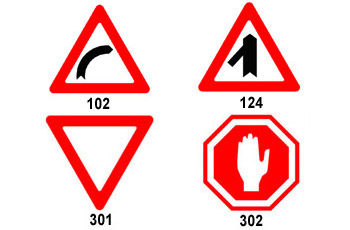
To make them more recognisable to drivers, and so that they can also be seen and interpreted correctly even under poor visibility conditions.✓ Correct answer
Because these two road signs are less important than other signs.
To enable pedestrians to notice road signs that are posted opposite their direction of walking.
Because these two road signs are more important than other signs.
Explanation. The Stop and Give Way signs have unique shapes (an octagon and an inverted triangle) so drivers recognise them instantly, even from far away or in poor visibility. The shape alone warns you that you must stop or yield.
End of Taxi station (rank) designated area.✓ Correct answer
Start of cab station designated area.
Cab station. Entry to the street in which this sign is posted is prohibited.
Cab station. Stopping or parking of other vehicles is prohibited.
Explanation. This sign marks the end of the taxi station area: the black diagonal stripe across it signals the end or cancellation of the zone. It is not an entry ban and not the start of the station.
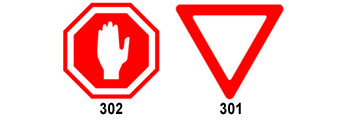
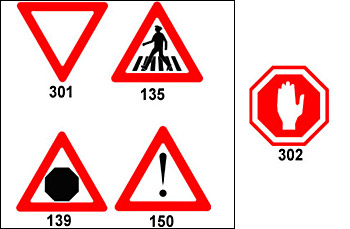
Explanation. Sign 302 (Stop) is the only one here that always requires a full stop. Its octagon shape is unique so it is recognised at once. Sign 301 (Give Way) requires stopping only if there is traffic to yield to.
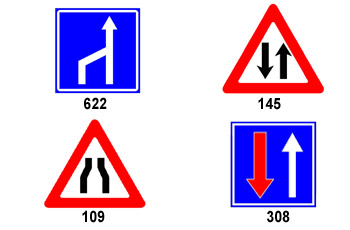
Explanation. Sign 622 is a blue information sign showing that a lane ends and merges, meaning the number of lanes changes. Sign 109 warns of a narrowing road and 145 of two-way traffic.
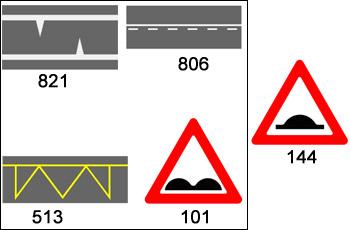
Explanation. Sign 144 warns of a speed bump ahead, and road marking 821 shows the bump itself on the road. They complement each other: first the sign, then the marking on the surface.
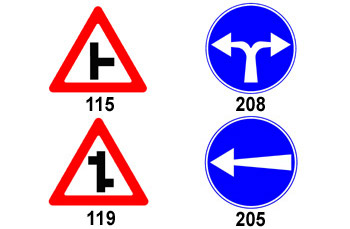
Explanation. Sign 115 is a warning triangle showing a side road joining on the right. Signs 205 and 208 are blue and set a mandatory direction of travel, so they do not warn about a junction.
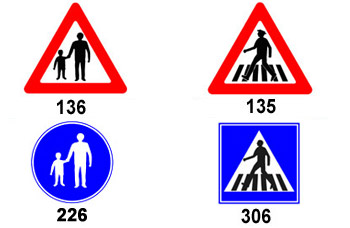
Explanation. Sign 136 is a warning triangle showing an adult and a child, and it warns that pedestrians are nearby. Sign 135 warns of a crossing, while 226 and 306 are blue signs, not warnings.
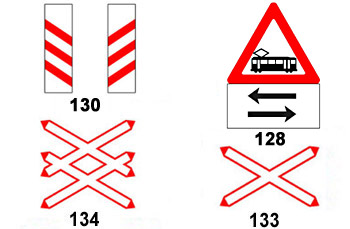
Explanation. About 300 metres before a level crossing, sign 130 appears with three diagonal red stripes. The number of stripes drops as you get closer, and at the crossing itself stands the cross sign 133 or 134.
Explanation. Sign 139 is a warning triangle showing a stop sign, and it is sometimes placed before sign 302 to warn that a stop is coming. The driver can then slow down before reaching the Stop sign itself.